

Arturo Izquierdo 8:36 pm No Comments
Do You Need a Tree Removal Permit in Fort Lauderdale?
As an ISA-certified arborist working here in South Florida, one of the questions I get most often is:
“Do i need a tree removal permit in Fort Lauderdale if the tree is on my property?”
Short answer: in many situations, yes.
The City of Fort Lauderdale treats trees as part of the city’s infrastructure. The local Tree Preservation Ordinance is there to protect the urban tree canopy and public safety.
Read on to learn when a tree removal permit is usually needed and how my team at Tree Motion handles the permit process.
Who is in charge of tree permits?
Inside Fort Lauderdale’s city limits, the main agency you deal with is the Development Services Department.
Through their permitting portal, they review tree applications, enforce permit requirements, host the tree permit application submittal process, and provide a Tree and Landscape Permit FAQ and Tree Trunk Diameter Chart under their Landscaping section.
Under that umbrella they enforce the city’s landscape and Tree Preservation Ordinance, which works alongside Broward County’s Tree Preservation and Abuse Ordinance.
Broward’s program regulates tree removal, tree relocation, licensing, and complaints about tree abuse, and it also oversees mitigation and replacement planting to maintain countywide canopy.
Other local governments around us – Pompano Beach, Pembroke Pines, Coral Springs, cities in Palm Beach County, and others – have their own tree codes and tree permit requirements that must be at least as strict as the county rules.
So once you cross a city limit sign, the rules about tree size, species, and mitigation can change.
When do you need a tree removal permit?
In Fort Lauderdale, any homeowner or tree removal service will usually need a permit when they remove:
- Large trees over a certain trunk diameter (measured at breast height, 4.5 feet above the ground),
- Required landscaping trees that appear on an approved site plan,
- Protected species or older heritage trees, or
- Trees whose removal could significantly impact the tree canopy, views along streets, or nearby power lines.
For most property owners other than developed single-family lots, a tree permit is normally required once a tree crosses the city’s minimum size threshold or palm trees reach a certain height, based on the city’s sizing charts and FAQ.
In many cases, especially with regulated or street trees, the city will also ask for an arborist report explaining the reasons for removal, such as structural defects, decline, or conflicts with infrastructure.
On commercial, HOA, and multifamily sites, nearly every structural tree on the approved site plan is regulated. Removing those trees without approval can lead to fines and even stop-work orders on construction projects.
When a permit may not be required
There are a few important exceptions where the process is much simpler, or where a permit may not be required at all.
1. Invasive or prohibited trees
Many invasive species are strongly encouraged to be removed.
In our area, that often means trees like Brazilian Pepper or Australian Pine. These are listed on Florida’s invasive plant lists and are widely recognized as problem species, so they’re treated differently from shade trees or native species.
Depending on the exact code section, the city may exempt them or require only basic proper documentation so they can verify what was taken out and what kind of tree planting happens afterward.
2. Hazardous trees on residential property
Florida’s state law on trees on residential property (F.S. 163.045) says a city or county can’t require a permit or mitigation if an ISA-certified arborist or Florida-licensed landscape architect provides an arborist report, which documents that the tree presents an “unacceptable risk” – in practical terms, a serious safety hazard where removal is the only reasonable mitigation:
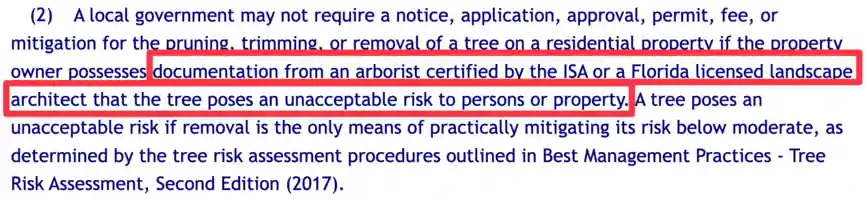
In those cases, your professional arborist becomes the key.
The local government cannot require a permit, but you still need that signed report as proper documentation in case questions come up later.
3. Routine pruning, not removal
Correctly performed tree pruning and palm trimming to ANSI A300 standards generally do not require a tree permit.
However, extreme cutting, topping, or other forms of tree abuse – as still regularly performed by inexperienced tree trimming companies – are explicitly prohibited in the county rules and can still violate the Tree Preservation Ordinance.
What does the permit process look like?
When my team handles permits in Fort Lauderdale, here is what the permit process typically looks like:
- On-site evaluation
I inspect the tree, its tree health, tree size, species (including whether it’s an invasive species or protected species), conflicts with buildings or power lines, and overall risk. When needed, I prepare an arborist report that meets the city’s expectations for proper documentation. - Application and review
We prepare a simple map or site plan with photos and notes. That package is submitted through the Development Services Department portal using their tree and landscape forms. Their staff then reviews the file, sometimes requests additional information, and completes their review process based on the city’s landscape and tree standards. - Mitigation and replacement trees
Approval often comes with conditions. You may need to plant replacement trees, perform tree relocation, or do extra tree planting. The goal is to rebuild the tree canopy using durable, storm-tolerant native species and to follow the city’s Tree and Palm List for Replacement Planting. - Scheduling the work
Once the permit is issued, we create internal work orders for the crew, plan rigging and removals, and schedule follow-up stump grinding, clean-up, and any required replacement planting.
Throughout the job we keep one eye on safety for your home and one eye on public safety around streets, sidewalks, and utilities.
What about emergency removals?
After storms or when a tree suddenly fails, emergency removals become necessary.
If the tree is already down or is an obvious hazard, the city will usually prioritize safety first and sort paperwork out afterward.
For a standing but risky tree on residential property, that’s where an arborist evaluation and written report is essential.
As I explained earlier, Florida state law defines when a tree poses an “unacceptable risk” and prevents local governments from requiring a permit or mitigation when that standard is met and properly documented.
In every emergency, we focus on stabilizing the situation, documenting the condition, and then handling any follow-up with the City of Fort Lauderdale or nearby jurisdictions.
Need help deciding what applies to your tree?
Whether you’re in Fort Lauderdale or nearby cities like Pompano Beach, Pembroke Pines, Coral Springs, or parts of Palm Beach County, you don’t have to decipher ordinances on your own.
My job as an arborist and owner of a professional tree care company is to help you understand:
- Whether your tree is regulated or exempt,
- Whether it qualifies for the hazardous-tree exemption on residential property,
- What kind of mitigation or replacement trees you may need, and
- How to schedule safe, regular removals and emergency removals, as well as follow-up stump grinding, and and tree planting, where required.
If you’d like clear guidance and a plan that keeps you compliant and safe, feel free to reach out to us today for a free consultation.
We’ll look at your trees, handle the paperwork with the City of Fort Lauderdale, and make sure the work is done safely, legally, and with respect for the trees and landscape you’ve invested in.
To learn more about our different services for homeowners and businesses here in Fort Lauderdale, you may also visit our Fort Lauderdale service page.

Arturo Izquierdo
Arturo is an ISA-Certified Arborist and advisory board member for the University of Florida’s Commercial Horticulture program for Broward and Palm Beach County. With 20+ years of experience in the tree care industry, he provides expert guidance on tree care, risk assessment, and proper landscape practices. He is also the owner of Tree Motion LLC, a Fort Lauderdale based tree care company.